Showing posts with label reading. Show all posts
Palindrome Days 2025 Learning FUN!

Palindrome Days 2025 Learning FUN!


Here's how you can have fun with palindromes in your classroom!

Download a free list of palindromes and fun activities here!

A palindrome is a word, phrase, or sentence that is spelled and read the same both forward and backward. Kids love to share simple palindromes like:
  • aha
  • did
  • dad
  • level
  • mom
  • noon
  • Anna
Older students often discover long words such as:
  • racecar
  • kayak
  • civic
  • repaper
  • solos
Keep working and you'll find phrases such as:
  • my gym
  • top spot
  • too hot to hoot
  • no lemon, no melon
  • don't nod
When you've run out of other examples, pull out these mind-blowing sentences:
  • Madam, I'm Adam.
  • A man, a plan, a canal: Panama.
  • Pull up, Eva, we're here, wave, pull up.
  • Was it a car or a cat I saw?
  • Mr. Owl at my metal worm.

Number Palindromes

Teachers can make a math connection with palindromes. Numbers that are read the same forward and backward count as palindromes. Go as simply as you wish - even a number such as 55 is still a palindrome. Challenge kids to create palindromic numbers like:
  • 12321
  • 42877824
  • 3434343
When a day, a week, or even a month contains a forward-backward date, math nerds and palindrome fans alike are delighted! This year, 2025, contains some palindromic dates and they're all in May! You'll want to celebrate these with your students!

In fact, now is a great time to introduce or review the concept of palindromes and set up some fun activities to mark these special dates.

Remember that different countries use different formats. We in the U.S. typically use a version of the Month-Day-Year format.

So, how do you celebrate Palindrome Week? Here are some ideas:

Don't forget your FREE list of palindromes and activities for math and writing!

Let me know how you celebrate palindromes in 2025!


Read More
Growing Grade By Grade
0 Comments
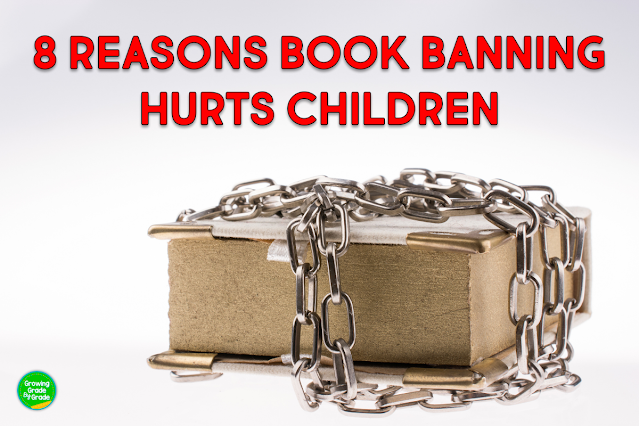
8 Reasons Book Banning Hurts Our Children

8 Reasons Book Banning Hurts Our Children


Book banning is here to stay. It has seasons of more attention and seasons of less. New books addressing new topics bring out detractors fully armed with reasons that specific books should be pulled from library shelves. 

This risky practice must be challenged. It is up to us as teachers, parents, and the community at large to stand against any attempt to ban books. Read on for eight important reasons that book banning hurts children.

Click here for the talking points of this post.

1. Book banning is censorship.   

Censorship is illegal in America. Freedom of speech is the foundation of our country and is protected in the First Amendment to the Constitution. Sharing information is part of our national personality and a pillar of our economy. Any deliberate obstruction to sources of information is, by definition, censorship. The consequences of censorship can be dire: lack of timely, useful knowledge is damaging to us now and in the future. By suppressing ideas and information, book banning is the literary version of cancel culture.

The American Library Association is an excellent resource for guidance. The ALA "resists all efforts to censor library resources". Read their Code of Ethics here.

2. Book banning is elitist.

Book censors believe they are superior in some ways and that others should fall in with their decisions. They believe their ideas and values are right and others are wrong. That’s a very slippery and dangerous slope to start down.

3. Book banning is privileged.  

Book censorship takes away personal choices from the majority of a community and gives them to a few people – or even to one person. It actually gives those in a position to ban books more power than the rest of us. 

Click here to access the American Library Association Guidelines For Reconsideration Committees

4. Book censors have ulterior motives. 

Supporters of banning books like to think they’re concerned for children. But what often drives them are religious, political, and social biases. We should be as concerned about the people who want to ban books as they are concerned about specific books. We need to ask: What is really motivating you? Racism? Homophobia? Politics?

5. Censors have a narrow perspective. 

Book censors impose a narrow perspective on others. They don’t understand the struggles that many children live with. They think the best way to handle these topics is to ignore them. But, when we ignore topics, we ignore the people they affect. It's as if we're telling them, “Your lives are unimportant. Your struggles are repulsive. Don’t share them with us.”

The very fact that book censors' messaging is, "Other people should think like I do", should put us all on alert.

6. The consequences of censorship are dangerous.

  • Censorship threatens our very democracy by violating our free speech. That may be the most crucial reason to reject all attempts at censorship. When we are stifled as to what we can read, watch, and see, we are no longer a democracy, but an authoritarian state.
  • Education can help level the playing field for citizens in different social situations. Horace Mann, a public school pioneer, called education "the great equalizer". 
  • Censorship is a threat to the potential of American public education. If teachers are afraid to teach critical thinking skills within the curriculum, we lose vital opportunities to develop critical thinkers.
  • Censorship breeds ignorance. When even our history lessons are censored, we miss vital opportunities to learn from the past and avoid repeating the mistakes of the past. 
  • Being censored limits information. Without the empowerment of information, citizens cannot challenge the status quo.  

7. Children need guidance, not censure. 

As a teacher and a parent, I found that children will self-regulate. If a book has topics that are too explicit or mature for that child, they will put it down and choose another one.

On the other hand, if a child does choose a book with mature themes, it means they are ready to deal with potentially tough topics. Then they need the adults in their lives – teachers, parents, clergy, and others - to support their choice, maybe read it with them, and help them understand what they’re grappling with. What they don’t need is these same adults taking books out of their hands and denying them the chance to grow.

One book, in particular, is being considered for banning in several states. It’s titled George, by Alex Dino, and is partly autobiographical. The most heartbreaking part is that the main character deals with an important self-discovery issue all alone in the 4th grade. Yes, many children are ready earlier than we think. 

One writer on the subject, Emily Grafton, made it simple: “Ignoring a kid’s reality doesn’t make it go away. It just means the kid gets to suffer alone.”

8. Parents' rights extend only to their own children. 

If parents want to restrict what their own children read, they have the right to do that – and they should. But, no parent has the right to restrict what other children read. Taking books from public school shelves is an attempt to control how other people’s children grow and think. Access to books is a pillar of our education system. Books should be available when students are ready for them.

It should not fall on the taxpaying parent to buy book after book for their children all because people in power are afraid of the topics.

If we really want kids to be “college and career ready”, we have to teach them to listen to others, accept that others have realities that we may not, empathize with them, and learn how to live in a world where everyone is different, but valued.

We should not bend to the will of a few, we should see the broader picture that is education and reject any attempt to ban books. 

If you'd like help starting a book club for kids, click here for an easy method that's budget-friendly.

Read More
Growing Grade By Grade
0 Comments
Why You Need To Teach The Brain Dump As A Test Strategy

Why You Need To Teach The Brain Dump As A Test Strategy


     Do you need a great testing strategy to teach your students? Think brain dump. I recently visited an amazing 4th-grade math class and was reminded of the power of this tool.

What is a brain dump?

     A brain dump is a transfer of knowledge and ideas to another storage medium, like paper or a computer document.  Its purpose is to store the material temporarily so we can access it while we use our brainpower to process information.

     To really understand a brain dump, be aware of what it is not.  It is not a:

Stream of consciousness that attempts to record all thoughts and feelings passing through the mind.

Brainstorm, which is an activity, often in a group, that produces new ideas and solutions to problems.

     Brain dumps can be used for academic, professional, or personal purposes, or a mixture.  A real-life situation can be seen as a 4th grader who is handed a geometry quiz.  The student takes a few minutes to “dump” onto a separate sheet of paper things like:

  • the definition of a kite 
  • a sketch of a trapezoid 
  • examples of acute, obtuse, right, and straight angles 
  • concepts that he is concerned he’ll forget or confuse during the quiz  

     He has learned that if he jots down the tricky information to refer to later, his brain is freer to think about the questions in the quiz.  Note: This is not a situation where students make notes outside of class to bring to a quiz, although that is a strategy some teachers offer.  This is only the information that the student can transfer during the assessment period.

     Another real-life situation might be for an overwhelmed high school senior to make an exhaustive list of all of the pre-graduation requirements she must accomplish during the often crazy last semester of school.  It gives her a list for reference as she checks off each task and relieves her worry that she’ll forget something. 

The advantages of a Brain Dump:

     A brain dump can be a powerful tool for students.   Some of the advantages are that a brain dump…
  • Builds confidence: Students can feel that “look how much I know” pride.
  • Reduces stress: If a student can capture info that she fears she’ll forget, that reduces her stress.
  • Organizes learning: Creating schemas, the cognitive structures that we use to organize knowledge and choose behaviors is central to learning.   When we can add to our schemas, learning grows.
  • Can help our EC students: When a child struggles to focus on a task, it can help to have a “parking” place for facts that often get lost while processing the task itself.
  • Is individual and personal: Each brain dump is personal to the child who created it.  The student “dumps” the information that is valuable to her/him, not what a teacher believes is useful. 
  • Is more meaningful:  We tend to buy into products that address our specific needs.
  • Is kid-centric: A child’s brain dump comes from his/her perspective.  Teacher-created materials, while well-meaning, come from an adult’s point of view.
  • Can be used with any medium:  Students can use any type of technology, from computers to paper and pencil.  It can also be used with a scribe.
  • Is created casually: There are no punctuation or grammar rules to follow, no must-have talking points, and neatness doesn’t count.  These are not to be graded!  Kids can relax about not being judged.
  • Can be used as a testing review tool: One of the best uses of a brain dump is during an assessment, whether a shorter quiz, a unit test, or even yearly standardized testing.  For all of the reasons listed above, it can be a powerful tool.

How to Create A Brain Dump

     Teaching students how to create a brain dump can be fun and casual, while still emphasizing its usefulness.  Here’s how:

1. Explain the purpose and advantages of the activity.  Consider using the list above.
2. Explain that the activity isn’t timed, but should only last a few minutes.  The purpose is not to spend all of your quiz time creating a brain dump, but to store information so your brain is freer to process questions.
3. Pick a familiar topic or one you’ve studied recently.
4. Decide how you’ll display as you’re teaching.  Consider using a document camera, a whiteboard, or a giant sticky chart/bulletin board paper.
5. Model as you go. Show all of the different ways you can express on paper what you’ve learned for the topic.  Use as many formats as possible, including sketches, diagrams, lists, computations, definitions, basic facts, and charts.  Talk about why you’re using each format.
6. Let students call out additions to your model.
7. Emphasize that the activity should only take a few minutes.  It shouldn’t take a large part of the assessment period.
8. If students have been writing along with you, let them share their work with a class gallery walk.  
9. If students have been watching you model and teach, they should be getting familiar with the concept. Now, it’s their turn!  Pick another practice topic and turn them loose.

     In the class I visited, the instructions were to "dump as many things as you can remember about math from this year".  That's a tall order, but the kids were up to the challenge!  Here's the brain dump I did with them.


When to Use The Brain Dump

     In a classroom setting, teach students to use a brain dump just before an independent activity, a quiz or test, or as a pre-assessment review.

     As they become more familiar with the process, encourage students to try using this powerful tool in their personal lives.  Challenge them to share with the class.  As it becomes a part of your class language and culture, you can all access it for growth.  I'd love to hear how it works in your class!

     Would you like another powerful tool for your students?  Grab these free Growth Mindset Math Posters!  They make a great, positive display to encourage your math students!

Read More
Growing Grade By Grade
3 Comments
Have Fun With Adverbs: Play In The Manner Of The Adverb!

Have Fun With Adverbs: Play In The Manner Of The Adverb!


     Students can get a little stuck when we study parts of speech. Nouns and verbs often go smoothly, but adverbs and adjectives can be challenging. And they both start the same (ad-), which can add an extra layer for kids to sort.

    I learned "In The Manner Of The Adverb" during my student teaching and it's never failed me. It's easy to teach, tons of fun to play, and it helps students internalize important concepts. 

     You don't even have to wait until you're teaching parts of speech to introduce it. It makes a great indoor recess game or brain break and is super at building collaborative skills. In addition, kids are very active, they practice expressive skills, and the game is supposed to be fairly quiet!

Materials You Need

  • a list of adverbs 
  • a list of actions that can be performed in the classroom. I've added both lists below to get you started.

How To Play

1.  Explain to students what an adverb is and how it's used. You don't need to go into a lengthy grammar lesson, you'll develop the concept by playing over time.

2.  Choose a student to be the Guesser and have her step outside of the room. No peeking through the window!

3.  Write an adverb on the board or a slate and silently show it to the rest of the class. It's important that no one says the adverb out loud. 

4.  Erase or hide the word and call the Guesser back in.

5.  Call on a student to silently perform a specific task in the manner of the adverb. Suppose your adverb is "quickly". You might say, "Jayden, please come shake my hand in the manner of the adverb." 

     Without a word, Jayden would quickly leave his seat, come shake your hand quickly, and return to his seat quickly

6.  The Guesser can now take a guess at the adverb. 

7.  If the Guesser misses, you may ask another student to perform a different task in the manner of the same adverb. You may give a third chance or whatever works for your group.

8.  Reveal the adverb to the Guesser. Choose a new Guesser and a new adverb.

Helpful Hints


  • Students can get excited about volunteering to perform. To keep everyone active and involved, I allow students to sit on their desks or stand around the room during the game.
  • Consider choosing two Guessers at a time. It avoids hurt feelings and embarrassment if a single Guesser misses the adverb. It also fosters collaboration.

  I'd love to hear how this game works for you! Best wishes!
Read More
Growing Grade By Grade
32 Comments
[name=Pat McFadyen] [img=https://blogger.googleusercontent.com/img/b/R29vZ2xl/AVvXsEhczE6mtgjdS5V3nWcCULBmAKHizsGN444Azjfc-ELJU4pYOVxAuVvcVGE029uyMOPBP-AUR_CJvQrMIVFpWzqAbwkwZ4EKslxl_weBhSbNsjgReTTdZq0IiCYvyyzXomhRuka_TgZ-Wd_Z/s1600/Pat.jpg] [description=My purpose is to support YOU and your students with practical solutions and curriculum materials that teach, play, practice, and assess.] (facebook=https://www.facebook.com/GrowingIn5thGrade/)

Follow @georgialoustudios